Field Notes / Journal
Delhi-Alwar RRTS: What It Means for Bhiwadi Property Prices
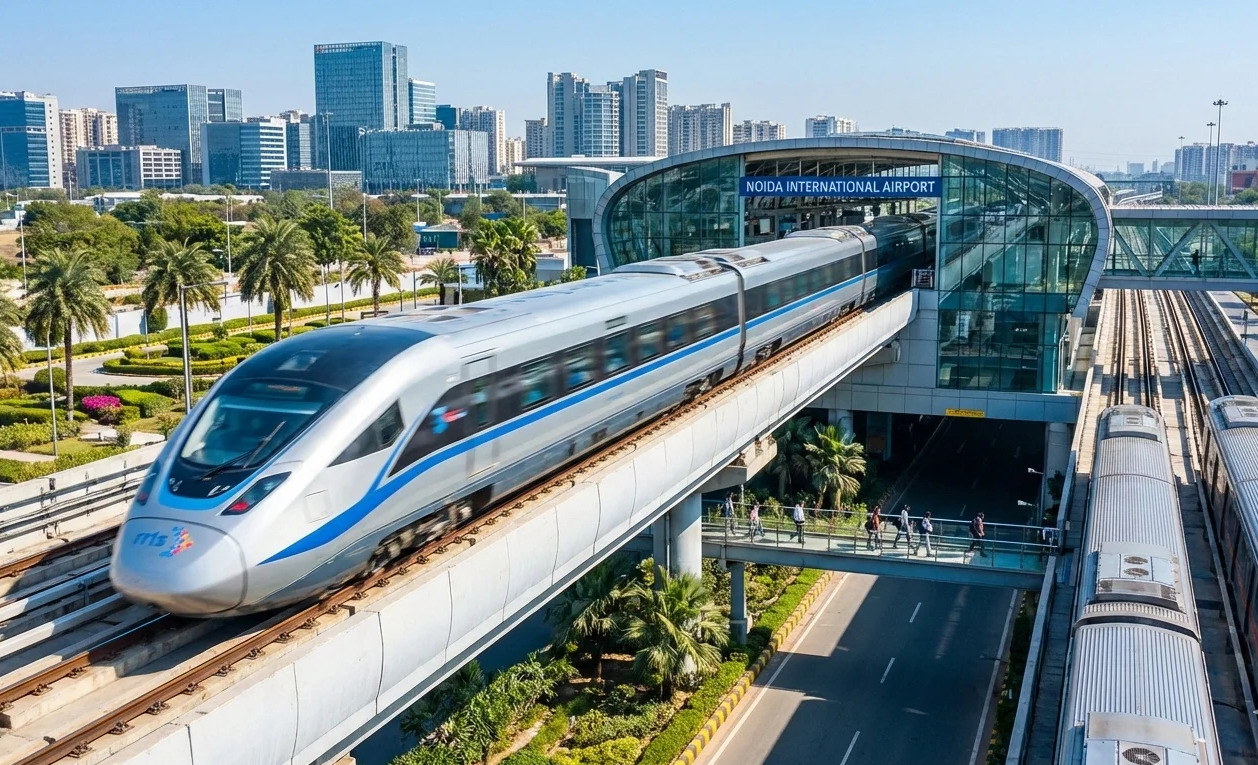
Of all the catalysts shaping Bhiwadi's real estate story
in 2026, none is more significant than the Delhi-Alwar Regional Rapid Transit
System. This 164-kilometre corridor represents the most consequential
connectivity upgrade the National Capital Region has seen since the Delhi
Metro, and Bhiwadi sits squarely within its path.
This article provides a detailed examination of the RRTS
corridor, its projected timeline, its impact on real estate prices in
comparable markets, and what it means specifically for property buyers and
investors in Bhiwadi.
1. Understanding the Delhi-Alwar RRTS Corridor
The Delhi-Alwar RRTS is part of India's National Capital
Regional Transport Corporation (NCRTC) programme to build high-speed regional
rail links connecting Delhi with its satellite cities. The Alwar corridor is
one of three priority corridors, alongside Delhi-Meerut (already operational)
and Delhi-Panipat.
Key specifications of the corridor:
•
Total length: 164
kilometres
•
Total stations: 22 stations
along the route
•
Operational speed: 160 km/h
design speed
•
Construction commencement:
April 2026 (expected)
•
Projected completion: 2031
•
Technology: Semi-high-speed
electric multiple unit trains
2. The Travel Time Revolution
The most immediate impact of the RRTS will be travel time
compression between Bhiwadi and Delhi. Currently, the commute from Bhiwadi to
central Delhi by road takes anywhere from 45 minutes in light traffic to over
90 minutes during peak hours. The RRTS will reduce this to a consistent,
traffic-independent 45 minutes.
Here is the projected post-RRTS travel time breakdown for
the corridor:
|
Sarai Kale
Khan, Delhi (origin) |
0 minutes |
|
Gurugram /
Manesar corridor |
~25 minutes |
|
Bhiwadi
station |
~45 minutes |
|
Alwar
(terminus) |
~90 minutes |
3. What RRTS Does to Property Prices: Historical Evidence
India has seen this pattern before. When major rapid
transit infrastructure is announced and built, property prices in the corridor
zones follow a predictable arc. Examining comparable corridors provides a clear
template for what Bhiwadi investors can anticipate.
Delhi Metro Impact — Dwarka Sector
When the Delhi Metro Blue Line extension to Dwarka was
announced, residential prices in Dwarka Sectors 10, 11, and 12 appreciated by
60 to 90 percent between announcement and full operationalisation. The
appreciation accelerated during construction, not after completion.
Dwarka Expressway — Gurgaon
The Dwarka Expressway was under construction for over a
decade. Investors who entered during the construction phase in 2010 to 2013 at
rates of Rs.3,500 to Rs.4,500 per sqft saw those same properties valued at
Rs.8,000 to Rs.12,000 per sqft by 2022, representing returns of 100 to 180
percent.
Noida Extension Corridor
Greater Noida West, connected progressively to Delhi via
the Aqua Line Metro, saw average flat prices move from Rs.2,800 per sqft in
2015 to Rs.6,500 per sqft by 2024 — a 132 percent appreciation driven
significantly by connectivity improvement.
The lesson from each of these corridors is identical: the
highest returns accrued to investors who entered during the pre-construction
and construction phases, not after ribbon-cutting. The Bhiwadi RRTS window is
currently open. Construction has not yet started.
4. Bhiwadi's Positioning Within the Corridor
Not every station along a rapid transit corridor
generates equal property uplift. Location within the corridor matters. Three
factors determine the magnitude of price appreciation for any given station
zone:
•
Proximity to major
employment centres — closer to Delhi generates higher uplift
•
Existing land prices —
lower base prices generate higher percentage returns
•
Industrial and commercial
density — zones with existing demand see faster absorption
Bhiwadi scores favourably on all three dimensions. It is
within the first half of the corridor from Delhi's origin point, giving it
strong Delhi-connectivity appeal. Its current land prices (Rs.1,100 to Rs.2,800
per sqft for plots) represent a low base for appreciation. And its 2,700-plus
industrial units guarantee demand absorption from day one.
The specific Bhiwadi RRTS station alignment will serve
the Tapukara-Khushkhera-Bhiwadi belt — the exact zones where current price
appreciation is already strongest. This is not a coincidence. The market is
already beginning to price in the connectivity premium. Early investors capture
the most of this repricing.
5. The Timeline Imperative: Why 2026 Is the Entry Year
The RRTS construction announcement follows a predictable
sequence of price impacts:
Phase 1: Pre-announcement (now)
Prices reflect current fundamentals — industrial demand,
local infrastructure, current connectivity. This is where Bhiwadi is today.
Sector 24 at Rs.6,000 per sqft, Tapukara at Rs.3,050 per sqft, Khushkhera plots
from Rs.1,100 per sqft.
Phase 2: Construction commencement (April 2026 onward)
Physical work begins. Media coverage intensifies. NCR
investor awareness of the corridor increases sharply. Prices typically move 15
to 25 percent in this phase as a new pool of buyers enters the market.
Phase 3: Mid-construction (2027 to 2029)
Corridor progress becomes visible. Station locations are
confirmed. Developers accelerate launches along the route. Prices move a
further 20 to 35 percent cumulatively from the Phase 1 base.
Phase 4: Pre-opening (2030 to 2031)
Completion is imminent. End-user demand spikes — NCR
professionals begin relocating to corridor towns. Prices reach their highest
single-year appreciation rate in this phase.
Phase 5: Post-opening (2031 onward)
The correction that never came. Prices stabilise at the new elevated level. Investors who entered in Phase 1 or 2 are sitting on 80 to 150 percent gains. New buyers are paying full connectivity-premium pricing.
6. Investment Zones to Watch as RRTS Construction Begins
With the corridor alignment factored in, the following
Bhiwadi zones stand to benefit most from the RRTS:
Khushkhera and Tapukara Belt
These zones sit closest to the proposed RRTS station
alignment. Plot prices from Rs.1,100 per sqft represent the most leveraged RRTS
bet. A 5 to 7 year hold through the full construction cycle could yield 80 to
120 percent returns based on comparable corridor data.
Alwar Bypass Road Corridor
The NH919 corridor will serve as the access road to the
RRTS station for a large part of Bhiwadi. Properties along this arterial road
benefit from both existing connectivity and RRTS proximity. Current rates of
Rs.2,750 to Rs.3,527 per sqft with 10% YoY appreciation will likely accelerate
post-construction start.
Sector 24 / UIT
Already the city's best-performing zone at 31.9% YoY
appreciation. The RRTS adds an additional premium layer to an already-strong
zone. For investors seeking a fully-managed township with proven appreciation,
Ashiana Tarang in Sector 24 remains the safest combination of quality and
growth.
7. What Investors Should Do Now
The practical implication of the RRTS analysis is
straightforward. Every month of delay in entering the Bhiwadi market is a month
of pre-RRTS pricing foregone. Here is a simple action checklist for investors
evaluating the opportunity:
•
Identify your budget tier
and corresponding zone (Khushkhera for plots, Tapukara for rental-income flats,
Sector 24 for premium township)
•
Verify RERA registration
for any shortlisted project at rera.rajasthan.gov.in
•
Check builder track record
— prioritise Ashiana, Krish, Terra, Omaxe, BDI Group
•
Arrange pre-approved home
loan before visiting projects for stronger negotiation position
•
Plan a physical site visit
— no property decision should be made on brochure alone
•
Factor in stamp duty (5%,
4% for women) and registration (1%) costs in your total budget
The Delhi-Alwar RRTS is not speculative infrastructure.
It has DPR approval, central government funding, and a construction timeline
that is tracking for April 2026 commencement. Bhiwadi is not a long-shot bet —
it is a data-supported investment in a city whose connectivity transformation
is imminent and whose price base is still rational.
All corridor and timing information is sourced from
publicly available NCRTC documentation and industry research as of early 2026.
Timeline projections are subject to government scheduling changes. Readers are
advised to independently verify current project status before investment.
Responses (0)
Be the first to share your thoughts on this architectural frequency.
Leave a Reply